

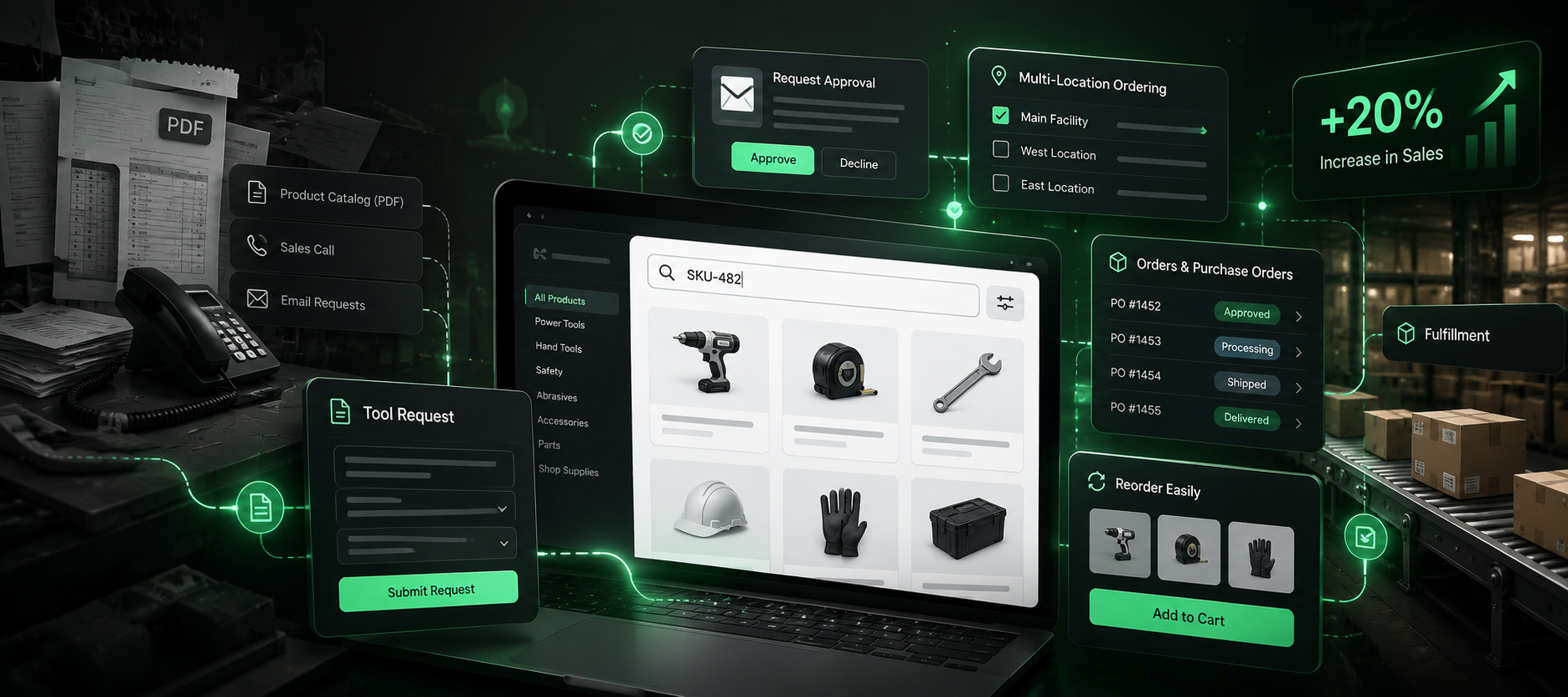
How we replaced a PDF-and-sales-call ordering process with a custom Shopify B2B experience that increased sales 20% and gave employees a faster way to request, approve, track, and reorder products.
The business had a large product catalog, but the purchasing experience was still heavily dependent on PDFs, sales calls, and internal coordination.
Customers often needed someone inside the company to help them find the right product, confirm availability, submit a request, or coordinate an order.
That created friction on both sides.
Customers had limited ability to browse and order independently, while the internal team spent time handling requests that could have been completed through a more structured digital experience.
The challenge wasn't simply launching a Shopify store.
We needed to take an existing offline process and turn it into a digital workflow without disrupting the warehouse, purchasing, and approval systems already in place.
There was an opportunity to make the buying process significantly easier without rebuilding the entire operation from the ground up.
The storefront could become the central point for:
The goal was to give customers more control while making sure every order still flowed into the processes the internal team already understood.
If customers could easily find products, submit their own requests, and track orders through a dedicated ecommerce experience, we could reduce the amount of manual coordination required to complete a purchase.
And if the Shopify workflows mirrored the company's existing operational processes, adoption would be easier for both customers and the internal team.
The result should be a faster purchasing experience, less internal friction, and more sales moving through the digital channel.
We started with the operating model, not the storefront.
Before deciding how products should be displayed or how requests should be submitted, we mapped how orders were currently being handled internally.
That included understanding approvals, warehouse fulfillment, purchase orders, locations, and the exceptions that couldn't follow a traditional ecommerce checkout.
From there, we built the Shopify experience around those workflows.
The project combined ecommerce development, merchandising, search optimization, workflow automation, operations, and team training.
We created a new Shopify store designed specifically around the B2B purchasing experience.
The catalog was loaded, structured, and organized so customers could move from browsing a PDF to navigating a searchable digital product catalog.
The storefront wasn't treated as a simple product migration.
We evaluated how the products should be grouped, discovered, and presented based on how customers actually looked for them.
A large catalog only works if customers can understand it.
We analyzed the products and created a more intentional merchandising structure around categories, collections, and product relationships.
The goal was to make it easier for customers to navigate the catalog without already knowing the exact product they needed.
Search was especially important because many customers already knew part of a product name, model number, or SKU.
We expanded the search experience to support:
This reduced the dependency on exact naming and made it easier for customers to find products using the information they already had.
Not every request could be handled through a standard Add to Cart experience.
We built a custom Tool Request Form that allowed customers to submit requests directly through the storefront.
Shopify Flow then routed those submissions into a streamlined approval process.
The appropriate team member received a custom email containing the request details and quick approval functionality, reducing the amount of back-and-forth required to move a request forward.
Some purchases fell outside of the standard product catalog or normal ordering process.
Instead of pushing those requests back into email or phone calls, we created a dedicated one-time request form.
That allowed exceptions to remain part of the same digital workflow while still giving the internal team the flexibility they needed.
The ecommerce experience needed to work with the warehouse, not create a second process for it.
We designed the order and request workflows around the existing fulfillment operation so the team could continue working within a process they already understood.
This made the transition to digital commerce significantly easier and reduced the operational risk that can come with introducing a new ordering channel.
We built a dedicated portal that gave customers a central place to manage their purchasing activity.
From the portal, users could more easily:
The goal was to make repeat purchasing faster while reducing the need to contact the internal team for routine updates.
The company needed to support customers purchasing across multiple locations.
We built that requirement into the ordering experience so users could manage purchasing more efficiently without treating every location as an entirely separate manual process.
For customers purchasing the same products repeatedly, discovery should not start from scratch every time.
Order history and portal functionality gave customers a faster path to repeat previous purchases and manage ongoing product needs.
Launching the storefront was only part of the project.
We documented the new process and trained the team on how requests, approvals, orders, and fulfillment would move through the system.
That helped bridge the gap between the ecommerce experience customers saw and the operational workflow happening behind the scenes.
The new storefront replaced a purchasing experience heavily dependent on PDFs, phone calls, and internal coordination with a more direct self-service model.
Sales increased 20% following the launch.
Customers could browse the catalog, search by product information and SKU, submit their own requests, track orders, manage multiple locations, and reorder without relying on an employee to coordinate every step.
Internally, requests became more structured.
Approvals could be handled directly from automated emails. Exceptions had their own workflow. Orders entered an operational process that was already familiar to the warehouse team.
The result wasn't simply a new ecommerce website.
It was a digital purchasing system that connected the customer experience to the way the business actually operated.