

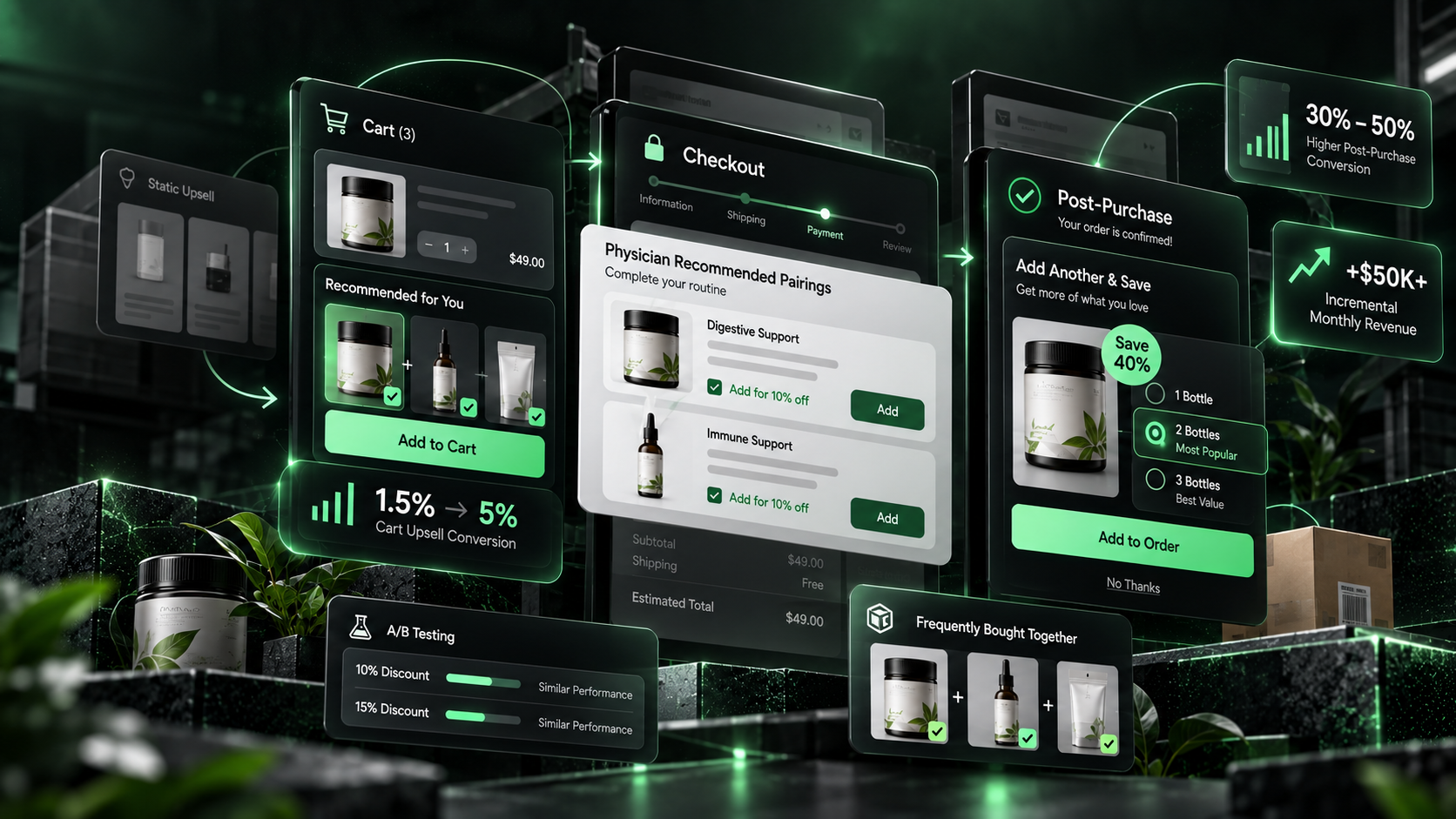
Rebuilding cart, checkout, and post-purchase merchandising around customer behavior, product relevance, and continuous testing to increase conversion without relying on unnecessary discounting.
The store already had upsell opportunities throughout the purchase journey, but simply having an upsell placement does not mean it is doing its job.
The cart included a recommendation module, but every shopper was shown the same products regardless of what they were purchasing. Checkout recommendations relied on fairly generic cross-sell positioning. Post-purchase offers created another opportunity to increase order value, but we needed to better understand what customers were actually willing to purchase after completing an order.
Rather than treating each placement as another place to display products, the goal was to understand the role each one played in the customer journey.
Customers had already demonstrated increasingly strong purchase intent as they progressed from cart to checkout to post-purchase.
That created three different merchandising opportunities:
The opportunity was not simply to add more offers. It was to make each offer more relevant to the point in the journey where the customer encountered it.
Upsell performance would improve if recommendations were based on customer context rather than static merchandising.
We believed each placement required a different strategy.
In the cart, product relevance should matter most.
At checkout, customers should understand why an additional product complements their purchase.
After checkout, customers may be more receptive to purchasing more of something they had already committed to than evaluating an entirely new product.
Testing offer strength alongside those merchandising changes would also help determine where additional discounting actually produced enough conversion lift to justify the margin.
We treated the purchase journey as a connected revenue system rather than optimizing each upsell placement independently.
Customer behavior and order data were used to guide which products appeared together, while messaging and promotional structures were tested separately to understand what was actually driving the conversion.
That meant evaluating four primary variables:
The objective was to find the simplest combination that increased conversion without giving away unnecessary margin.
The original cart upsell experience displayed the same products to every shopper.
We replaced the static merchandising strategy with dynamic recommendations that could respond to the products already in the customer's cart.
That change alone increased cart upsell conversion from approximately 1.5% to 5%.
The result reinforced an important principle: relevance was more valuable than simply increasing the visibility of an offer.
Checkout required a different strategy.
Generic cross-sell language such as "You May Also Like" gave customers little context for why another product was being introduced at that point in the journey.
We repositioned the experience around more specialized messaging such as "Physician Recommended Pairings."
We then paired that positioning with purchasing data to identify products customers frequently bought together.
Instead of asking shoppers to consider another unrelated product, the experience explained how products complemented the purchase they were already making.
Discount testing also showed that a larger incentive did not always create a meaningful increase in conversion.
When comparing 10% and 15% discounts, performance remained relatively similar.
That made the decision straightforward: when another five percentage points of discount did not generate enough incremental conversion to justify the additional margin loss, there was little reason to offer it.
Testing allowed us to settle on the more margin-efficient incentive rather than assuming that a larger discount would automatically perform better.
Post-purchase behavior was noticeably different from cart and checkout behavior.
Customers were more receptive to purchasing additional units of a product they had already decided to buy than evaluating a completely different cross-sell immediately after checkout.
That shifted the strategy from:
"What else can we sell this customer?"
to:
"How can we extend the purchase they just made?"
Testing also showed that stronger post-purchase incentives in the 30%–50% range resulted in higher conversion rates.
Because the customer had already completed checkout, the post-purchase placement gave us room to test more aggressive offers without interrupting or complicating the original purchase.
The project transformed upselling from a collection of static promotional placements into a more intentional merchandising system.
Dynamic cart recommendations materially improved conversion.
Checkout became less about showing another product and more about explaining a relevant pairing.
Discount testing helped protect margin by identifying situations where a larger incentive provided little additional benefit.
And post-purchase testing revealed that increasing depth within an existing purchase could outperform introducing something entirely new.
More importantly, the work created a repeatable framework for future optimization.
Instead of asking whether the store should "have upsells," we could evaluate each opportunity through the same questions:
Is the product relevant? Is the message relevant? Is this the right point in the journey? And are we paying for discount that actually changes behavior?